May Flower
Mariners' Museum, Uncurated Search Results
Type: Skipjack
Year: 1897
Builder:
Location: Tappahannock
These records are found in the online catalog of The Mariners’ Museum and Park in Newport News, Virginia. Uncurated search results are presented to give researchers and interested readers an idea of whether the museum’s archives contain information about this vessel and whether it may be worthwhile to visit the museum’s catalog search page for further investigation. Uncurated results may be inaccurate or incomplete.
Search mode: Type+Name and Schooner+Name. Search phrase(s): "Skipjack May Flower"; "Schooner May Flower". Results returned: 1. Results displayed in this table: 1.
Use these buttons to send uncurated search results to your own app or text document for further research. First, check the box for any row, or click "Select All" then uncheck any rows. Then click "Show Selections". You can then copy your selections from the text box and past them into your app.
| Fetch? | Row ID | Media | Date | Vessel | Place | Related Places | Inscription/Marks | Subject | Notes | Archive Number |
|---|---|---|---|---|---|---|---|---|---|---|
| 1 | 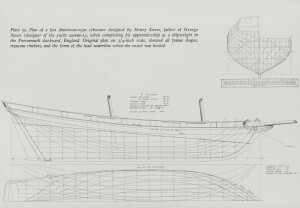 | SHORT DESCRIPTION: Prototype half hull model, starboard side. Howard Chapelle feels this model was for a typical square sterned 12- or 14-gun American schooner of 90’10” length. The model is a basic representation of the vessel's molded lines, without constructional details. The model is not mounted on a backing board. The model may have been varnished at some point in the past but it appears to have been removed. There are some remnants of varnish visible near the stern and around the vessel’s name. It is inscribed in black letters “Built By H. STEERS, 1805.” [see note below] There are decorative flourishes to either side of the date. The model has a slightly raked stem and a square stern with a knuckle in the wedge forming a small counter that begins in lift 13. The counter is 1-7/8”. The transom or upper stern is 1-13/16”. The stem is slightly raked and the bow/entrance is short, only 8” of the model’s 46-5/8” length. The stern is raked. It has moderate deadrise and no tumblehome. The model is constructed of 16 lifts and two wedges between the 14th and 15th lifts. The lower 14 lifts are flat and arranged in pairs each consisting of a 15/16” lift of mahogany and a 1/6” lift in a light colored wood. The bottom lift (1) is flat from the first 10-1/2” from the stern and tapers for 11” (the last inch is missing). It disappears about 17” from the stem. The sheer curve is created by two wedges above the 14th lift. The wedge at the stern is 1-1/8” high and 16-3/4” long and tapers 0”. The wedge at the bow 1-3/4” high and approximately 2’ long and tapers to 0”. Near the center of the model, underneath the words “Built By H” the thin lifts 14 and 15 are touching. Lifts 15 and 16 curve with the sheer created the wedges. The 16th lift is also the top covering for the model, which is not hollowed out to deck level. The dimensions of the model are 46-5/8” (length overall); 5-5/8” (main breadth), 5-1/2” (half breadth). Height overall is 9-5/8” (at the stern). The minimum half-breadth of the model is 1/8" along the edge of the stem and 1/8” at the stern. The lifts are held together nine large pegs running from top to bottom and several small nails appear to be holding the bottom lift in place although these may be part of a later repair. There are a few scattered holes on the top of the model. There are a few variously sized holes whose purpose is not apparent on the back. The model has watermarks running down the center front. There have been some repairs in the past most notably near the stern on the bottom three lifts. There is a small loss at the bow at the ends of the 3rd through 5th lifts. There is some separating between lifts 7 through 9 and the bow and lifts 9 through 12 have what look like repaired cracks at the bow. The tip of the bow at the top has a small loss. The transom also has some small losses along its upper edge. There are a few random nails and holes on the front surface of the model. NOTES: [Willoz-Egnor, 6/18/2022] There is no evidence of dowel channels typical to builder's half-models on this piece. This is backed up by xrays. While this is just a theory, looking at the two engravings showing George and Henry's model rooms, the model does not appear in George's but there is a suspiciously similiar model laying on the floor in Henry's room. You can also see the framed Henry Steer plan of a schooner (1805) in the image of Henry's model room. Might this suggest that Henry (1832-1903) made the model? NOTES: According to the article "Men Who Have Made Yachting: George Steers" by Thomas Day (published in The Rudder, Vol. XVII, February 1906, page 54), Day states that although George Steers undoubtedly worked at all branches of the [shipbuilding] trade, it is probable he was employed chiefly in making models, for it is said that, after he had...proved the possession of an eye for the proper form, he made all of his father's models." According to Dr. Charles K. Stillman in the booklet "The Development of the Builders' Half-Hull Model in America" builder's models most likely began being used in the United States in the late 18th or early 19th century which brings into question the dating of this model despite the presence of the inscription. It is well known that some of the models accumulated by the Steers shipbuilders had been tampered with later in their lives, so its possible the inscription was added much later and stated what was "believed" about the model rather than what was "known." Given Day's comments about George's model making could it be that it represents a model George made of one of Henry's designs? Find a Grave indicates that Henry Steers Sr. was born in 1783 [a ship's manifest for the schooner May Flower dated 1833 supports this, Henry's age is listed as 50] and died in March 1841. He was originally buried in Williamsburg, New York but his remains were moved and moved on March 9, 1870 to Green-Wood Cemetery in Brooklyn (into the J.R. Steers tomb). In 1831 Henry was sent to Mexico by a New York company to seek treasure in a wreck, spending three years in the work and raising a large part of the treasure. The last years of his busy life, to his death in 1841, were spent in similar lines of work, mainly about New York. NOTES: Chapelle believed the model was made from one of the plans drawn by George Steers's father Henry Steers on Isle of Guernsey before he came to America in the year 1819. In the book "The History of the American Sailing Navy" Chapelle states this about Henry Steers: In 1819 an English shipwright named Henry Steer applied for work in the Washington Navy Yard. Steer was born at, or near, Dartmouth, England, in 1780 [1779]. He learned his trade under a builder named Newman in New Quay, and after completing his apprenticeship he went to work in the Plymouth Dockyard. In 1815 he went to the island of Guernsey and worked for the French government. He was not only a shipbuilder, but also a competent draftsman and designer. A fellow shipwright in the Plymouth Dockyard, John Thomas, also a competent builder and designer, had gone to America and was working in the Washington Yard. Thomas wrote Steer suggesting that he come to America and, a depression occurring in the trade in Great Britain at this time, Steer and his family--wife and two sons, James R. and Henry T.--arrived in New York and went from there to Washington. A third son, George, was born in Washington in 1820 [actually 1819]. Henry Steer was employed on the schooners Shark and Grampus, apparently acting as charge man, and remained in the yard until 1822 [actually 1824]. His sons Henry and George became distinguished ship designers. The younger, George, designed the yacht America and many pilot boats, as well as the clipper ship Sunny South. Henry Steers (an "s" having been added to the name by usage) was the designer of the famous Collins steamer Adriatic [nope, it was George] and of many other noted vessels. It has sometimes been claimed that Steer designed the Shark and Grampus, but this can readily be shown to be an error (the vessels were designed by Henry Eckford). Interestingly this book was published in 1949 and in a February 13, 1963 letter to Mr. Robert Burgess, curator of exhibits at the Mariners' Museum, Chapelle states: "I now wonder if it could be a model of the USS Shark which Henry Steers worked on in Washington when he first came to the US." In the article “The Evolution of the American Yacht” by S.G.W. Benjamin in The Century Illustrated Monthly Magazine, Volume 24, pages 355 and 357 Benjamin also discusses Henry Steers and the USS Shark and provides a line drawing of the Shark that matches this model. NOTES: Information from Henry Steers, III: From a journal/autobiography of James Rich Steers transcribed by his son just before his death: "Henry Steers left Plymouth in the spring of 1815 with his family (a daughter, Ann, remained behind in England ) for the Isle of Guernsey, one of the Channel Islands, under contract as a draughtsman for a firm of shipbuilders. These shipbuilders had made contracts with some "French merchants" to build several sailing vessels for them, and to guarantee first speed, second, stability and third, safety. A ship design father had drawn up during his employment at the Royal Plymouth Dockyards in 1805 was accepted by the firm. Three vessels were finished from these lines and accepted." According to family lore these French merchants as it turned out, were smugglers--perhaps the reason that speed was deemed more important than safety. Father also built one bark that was ready to launch by the time he left in April 1819 for Washington. NOTES Text from The Search for Speed Under Sail 1700-1855 by Howard Chapelle, page 189: It has been pointed out that the American sharp seagoing schooner had become so well-known abroad by 1800 that European constructors were able to produce schooners on the American model. Plate 50 is an example. It is a design made in 1805 by an English shipwright apprentice named Henry Steer or Steers. This drawing differs from the original in not showing every frame and in not having the heeled load waterline projected. The original plan seems to have been drawn by Steers as a final examination on completing his apprenticeship. There is no indication that the plan was built from, it was probably a project or a test of seamanship. The plan (plate 50) was for a large 12- or 14-gun schooner of the American model 90’10” between design perpendiculars, 90’10” on the upper deck, 23’2” moulded beam, and 9’9” depth in hold. The design is marked by heavy drag to the keel, strongly raking ends, strong sheer, a midsection formed with sharply rising straight floor, high and easy turn of the bilge, and with some tumblehome in the topsides. The entrance is sharp, convex, and rather short. The run is long and very fine, with hollow in the buttock under the quarters. [Willoz-Egnor, October 2, 2020: The plan Chapelle is referring to is an actual drawn plan that originally came to the Museum with the Steers collection of half models. Unfortunately the plan was loaned to Chapelle for study and was lost. See 1936.1508.000001 for a digital copy.] The projected schooner would have been 82’3” long on the moulded load waterline, with a moulded displacement of 176.3 long tons. Her block co-efficient was .36, her midship coefficient .60, and her prismatic coefficient .59. The effective length of the quarterbeam buttock was about 57’9” and its camber 5’5”, giving a camber-length ratio of 10.7. The apprentice designer of this schooner, Steers, came to America shortly after the end of the War of 1812, and was employed in Washington Navy Yard. He later removed to New York, where he and an associate built the first marine railway in that area. | CL14545 |
Created 2026 by Don Barker, CBMM volunteer, for the Chesapeake Shipbuilding Project. shipbuilding@sailingworkboats.es